Custom Cat Paint by Numbers From Your Cat's Photo
We may earn a commission when you buy through links on this page, at no extra cost to you. How this works.
Upload a photo of your cat and get a printable cat paint by numbers pattern in seconds: numbered outline, color preview and a palette sheet with every color. It's free, needs no account, and the photo is processed in your browser so it never gets uploaded. Under the tool are notes on the parts of a cat that trip people up, mainly eyes and whiskers.
Fewer colors are easier to paint. 12 to 24 suits most photos.
Higher detail keeps smaller shapes. Lower is relaxing, higher looks more like the photo. 8 and up keep fine lines and text.
Getting a usable cat photo
Cats don't pose. You know this. So instead of chasing the perfect shot, work with how cats actually behave.
Sleepy cats are the best models. A cat curled up in a sunny window, half awake, will hold still long enough for twenty photos. Window light from the side is also exactly the light you want: it gives the fur clear highlights and shadows, which become separate paintable areas.
For eyes open and alert, sit at their level and make a small noise (crinkling paper works on most cats). Take a burst and pick the frame later.
Skip the flash. It flattens the fur and can turn the eyes glowing green or yellow, which the generator will faithfully reproduce as a pair of neon disks.
And look at the background before you shoot. A cat on a patterned rug or a cluttered couch will give you a painting that's mostly rug.
Eyes and whiskers
These two features are what make a painting look like a cat instead of a furry shape.
Eyes. Cat eyes have a lot going on: iris color, a slit or round pupil, a darker rim, and a catchlight. In the preview, zoom in on the eyes. If the iris and pupil have merged, allow smaller areas in the detail setting or add colors until they separate. It's worth getting right. Everything else can be a bit rough.
Whiskers. Here's the honest bit: whiskers are too thin to survive as paint by numbers areas. Any setting fine enough to keep them would turn the rest of the cat into dust. So don't fight it. Paint the cat, let it dry, then add the whiskers at the end with a fine liner brush or a white paint pen. It takes five minutes and makes a big difference. Same goes for the fine hairs inside the ears.
Settings by coat
Tabby (brown, grey, orange). Stripes are basically made for this format. 20-28 colors keeps the stripes distinct from the base coat. If stripes start breaking into dots, make the minimum area a bit larger.
Black cats. Like black dogs, they need good light to show any form. Use a photo where you can see the sheen on the fur, and go for 18-24 colors so you get several dark tones instead of one. The eyes will carry the painting, so check them carefully in the preview.
White cats. Shoot in shade or soft window light so the fur doesn't blow out to pure white. 14-20 colors, mostly pale greys, creams and a hint of pink around ears and nose.
Tuxedo and bicolor. High contrast and graphic. These look great even at 12-16 colors.
Calico and tortie. Patchy, multicolored, and a lot of fun to paint. Give them 24-32 colors so the patches keep their own shades.
Sizing and printing
A single cat head works at 8x10 or 11x14. A full curled up cat looks best at 11x14, since the body takes up space and the face gets smaller. Two cats napping together: 16x20.
Letter and A4 print at home. For the larger sizes, take the PDF to a copy shop and ask for it at 100% scale, so it lines up with your canvas.
Transferring the pattern
Trace with graphite transfer paper or a light pad, then mark the numbers very lightly in pencil. White and cream fur won't cover dark pencil well. See our transfer guide for the full method.
For cat people at gift time
A painting of their own cat is close to a guaranteed hit with any cat owner. If you're putting one together as a gift, include a paint pen in the box with a note about the whiskers. They'll appreciate the tip. Our gift ideas guide has packaging suggestions, and the pet portrait page covers other animals if the household has a rabbit or a bird as well.
Supplies for cat portraits

Anezus tiny detail brushes, 30 pack
Size 000 liners are what you want for whiskers, ear hairs and the thin rim around a cat's eye.
View on Amazon
Grabie black and white paint markers, 0.7mm
Extra fine acrylic markers for adding whiskers after the painting dries. The black ones handle whiskers on white cats.
View on Amazon
Nicpro white acrylic paint, 500ml
White cats and cream fur use a lot of white for tints. A big bottle stops you running out mid painting.
View on Amazon
GOTIDEAL 11x14 canvas panels, 7 pack
The best size for most single cat portraits. Flat panels are easy to trace onto with a light pad.
View on AmazonPaint sets to start with
 TMOL Acrylic Paint Set, 24 Colors (2 oz/Bottle) with 12 Art Brushes, Art Supplies for Pa…View on Amazon
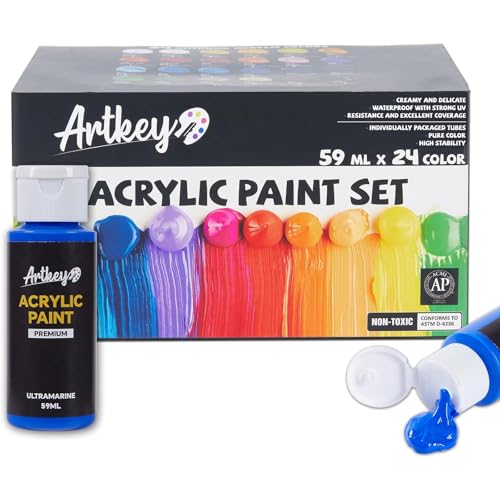 Artkey Acrylic Paint Set, 24 Colors 2 oz/59 ml Acrylic Paint Kit for Professional Artist…View on Amazon
 Acrylic Paint Set Canvas Art Paints 24 Colors Perfect Paint Finish (0.41oz,12 ml) With 3…View on Amazon
 Shuttle Art Acrylic Paint, 24 Colors Acrylic Paint Bottle Set, 250ml/8.45oz Each, Rich P…View on Amazon
FAQ
Can I get whiskers in the pattern?
Usually not, they're thinner than any paintable area. The trick is to paint them on at the end with a liner brush or a fine paint pen. It looks better that way anyway, since you control the curve.
My cat's eyes look muddy in the preview. What do I change?
Allow smaller areas in the detail setting, add a few colors, or try a photo where the eyes are larger in the frame. Cropping tighter on the face often fixes it without changing settings.
What size should a cat paint by numbers be?
11x14 suits most single cat portraits. Go 8x10 for a simple head shot or a beginner, and 16x20 if there are two cats in the photo.
Is a black cat too hard?
No, but the photo has to show light on the fur. Pick the shot with the most visible shine, use 18 or more colors, and it'll come out with real shape instead of a silhouette.